Mota-Engil: The Portuguese Colossus. Is It Worth the Risk?
A fundamental and technical analysis of Mota-Engil at €4.48, because I think the Portuguese construction group is undervalued.
By Ricardo Alves · · 11 min de leitura
- Company
- Mota-Engil, SGPS, S.A.
- Ticker
- EGL
- Exchange
- Euronext Lisbon
- Sector
- Engineering and Construction
- Share price on the date
- €4.48
- ISIN
- PTMEN0AE0005
Brief summary
I think Mota-Engil is fundamentally undervalued. At €4.48, today’s closing price, and assuming management delivers the €180M of net profit it promised for 2026, the company trades at a P/E of 7.6, when a multiple of 15, which seems acceptable to me for the sector, would give a share price close to €8.8. The central argument is simple. The revenue in the guidance has practically been reached, what is left is to improve profitability, and that is exactly what the numbers of the last three years show happening, with the net margin rising from 2.0% to 2.5% and the backlog at a high, at €16,153M. Against this weighs the growing debt, the geographies where it operates and the sensitivity to economic cycles. At least until the results on 27 August, I am keeping the position I have been building since 2024.
Numbers I consider relevant
| 2023 | 2024 | 2025 | |
|---|---|---|---|
| Backlog (€M) | 12,936 | 15,602 | 16,153 |
| Revenue (€M) | 5,552 | 5,951 | 5,301 |
| EBITDA (€M) | 837 | 941 | 979 |
| EBITDA margin | 15.1% | 15.8% | 18.5% |
| Net debt (€M) | 1,175 | 1,732 | 1,941 |
| Net debt / EBITDA | 1.40x | 1.84x | 1.98x |
| Net profit (€M) | 113 | 123 | 133 |
| Net margin | 2.0% | 2.1% | 2.5% |
Two notes on this table. The 2024 EBITDA appears as €941M and not as the €955M that year’s report stated, because the group restated the figure in the 2025 report, following a change to the accounting policy for government grants. And I use the restated figure so that the three columns are comparable with one another. It is also that figure that explains the 1.84x ratio in 2024. And the net profit is the one attributable to the Group, not the consolidated profit for the year, which in 2025 was €248M.
Short introduction
I want to start by saying that, although I do hold shares in this listed company, I will do my best to be as impartial as possible in my analysis.
I thought this was a good moment to analyse the company, because it will report first-half results next week, on Thursday 27 August.
It is a company I have been following for some time, with a long history behind it, which makes it a company with mature processes, and one spread quite widely across the map. For reasons of article length I am not going to go through the company’s path in detail, but it has a very interesting history.
One thing I like about the company is that the Mota family’s holding company owns a large slice of it and has plenty of skin in the game. The other large stake belongs to China Communications Construction Company, Ltd., a Chinese state-owned enterprise and one of the largest engineering and construction companies in the world.

I have also been following the work and the strategy of Carlos Mota Santos, and I have a good deal of regard for his leadership.
Mota-Engil SGPS, S.A. is not only Engineering and Construction, it is an enormous company, with a great deal of business that goes beyond what it is normally known for (Engineering and Construction).
For anyone who has never looked at it, the essentials are these. The group makes money building infrastructure on behalf of others — roads, railways, airports, ports, dams and buildings — and it has already done so in around 50 countries.
Today it is Africa that weighs most in revenue, with 40%, followed by Latin America, with 38%, and only then Europe, with 7%. Outside construction, and this is the part that usually goes unnoticed, there are the industrial engineering services, which are the provision of services to mines and one of the group’s growth engines. There is Environment, with waste collection and treatment through Suma and EGF, which on its own is worth 12% of revenue. And there are the road and bridge concessions through Lineas, some 2,500 kilometres that include Lisbon’s two bridges. Then there is also energy, real estate and a capital arm, with small weights. Here is the breakdown of 2025 revenue, which gives two things at the same time: the weight of each geography and the weight of each business area.
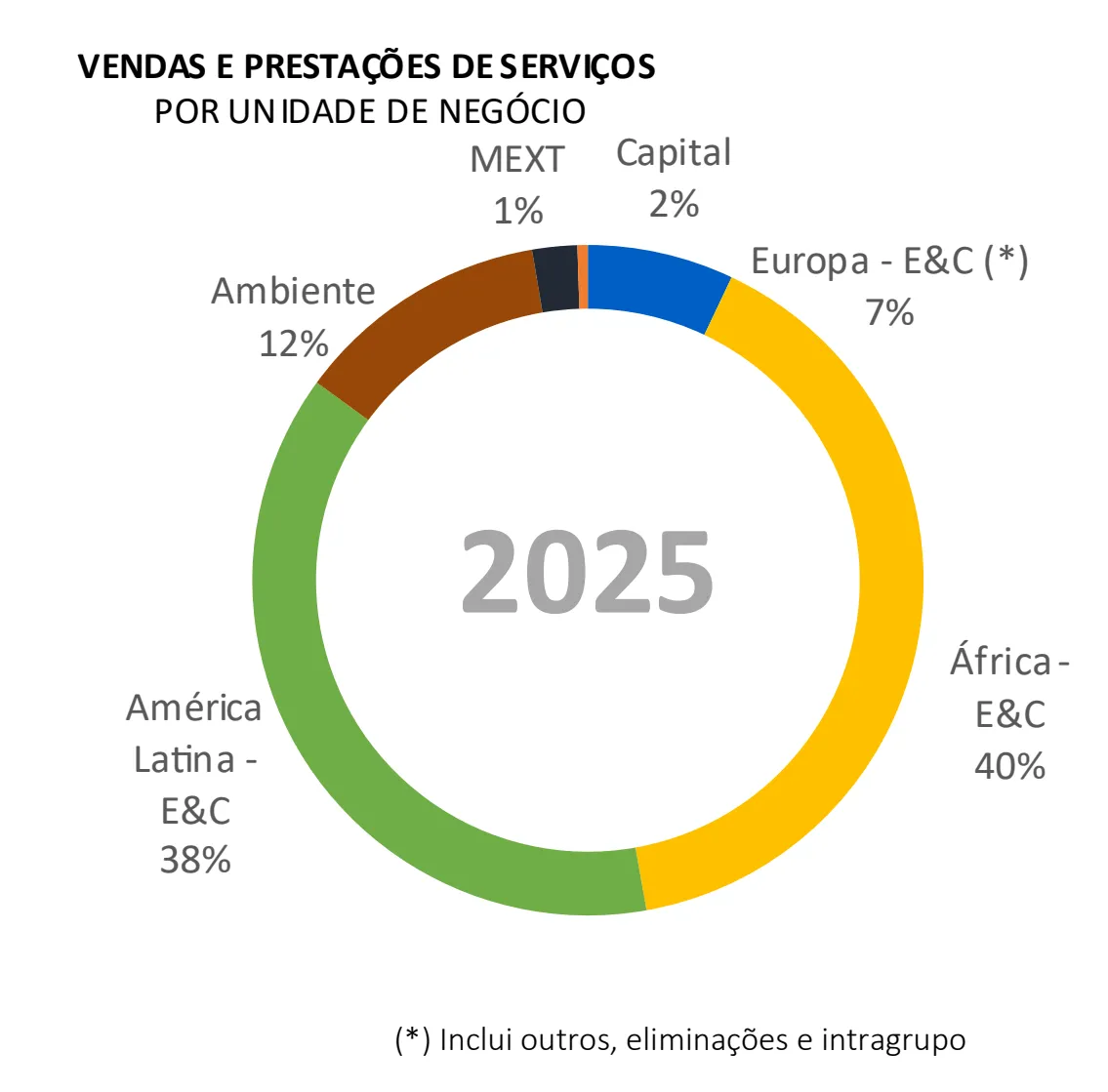
If you want to get to know it better, I would advise reading the annual reports.
Fundamental analysis
Looking at the fundamental side of the company, and with the numbers of the chapter before the introduction in mind, as well as the rest of the information in the annual reports, including the guidance given for the end of 2026, we can conclude that management’s big focus right now is improving the profitability of the business.
From what the numbers tell us, this goal is being met, given the rise in the net margin and, consequently, in net profit. This increase in margin comes not only from efficient management of capex and opex, but also from the reduction of something that has been taking a lot of profit away from the group: minority interests. By buying out partners, such as ECB in Brazil, the group has managed to reduce the profit it shares, in consortium, with other companies, and that of course raises the net margin and, consequently, the net profit attributable to Mota-Engil. Other factors pushing the margins up are a bigger bet on projects with a higher operating margin, such as projects in Africa and in Industrial Engineering (the mining sector), and the fact that the tenders being won are getting larger and larger, which reduces the capex and all the surrounding logistics versus the return the project delivers.
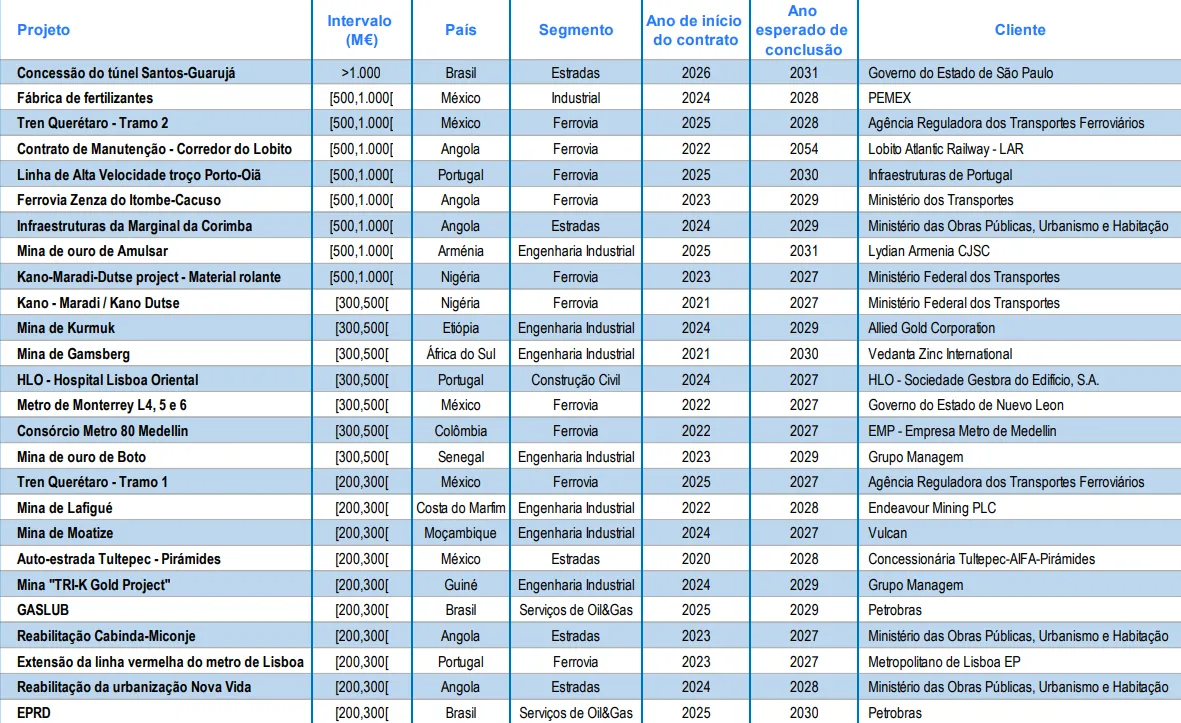
We can see that the backlog has grown a great deal and is at impressive levels. Out of curiosity, and to show the largest Mota projects, here is an image taken from the first-quarter 2026 trading update.
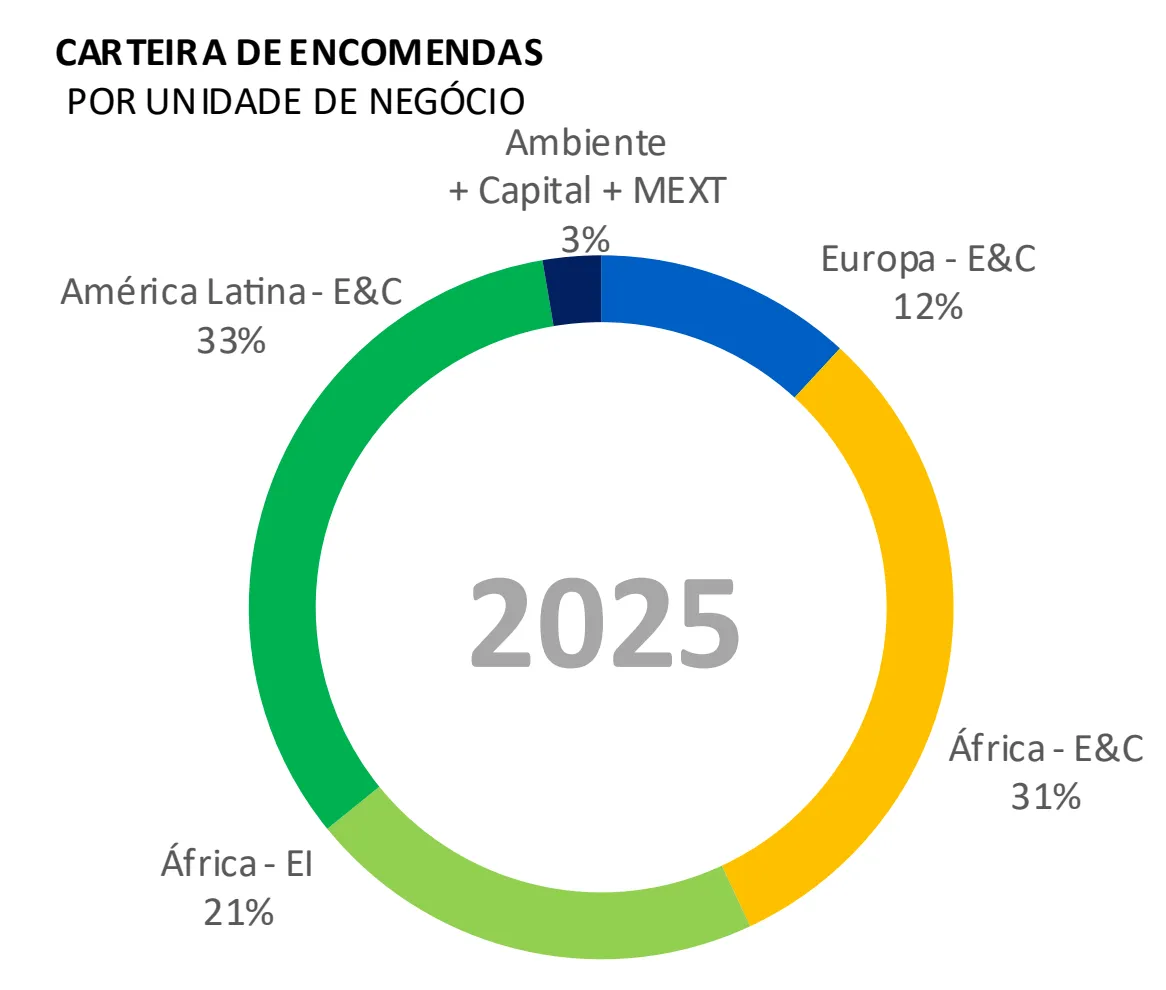
And to show where that order book comes from, here is its breakdown by business unit as well.
Even so, it is not enough just to have an enormous order book, you also need the capacity to convert that backlog. On that point, we can see that revenue fell in 2025. Management’s explanation for this was the delays to the works in Portugal, which is indeed a real thing. Honestly, for me this figure is not even critical, because the revenue management forecasts for the end of 2026 is €6,040M, which is to say it has practically been reached already. Even so, the trend in this indicator needs to be followed closely.
We can also see, from the numbers presented above, that the group has been increasing its net debt, which I consider normal given the growth in the backlog, which does not generate an immediate return. It is important to note that, although net debt / EBITDA has risen, in my opinion this ratio remains acceptable for the sector (management committed to keeping the ratio below 2x in its guidance for 2026).
Speaking of guidance, I would also like to show the path management is following for 2026 and the reason why I think the company is fundamentally undervalued.
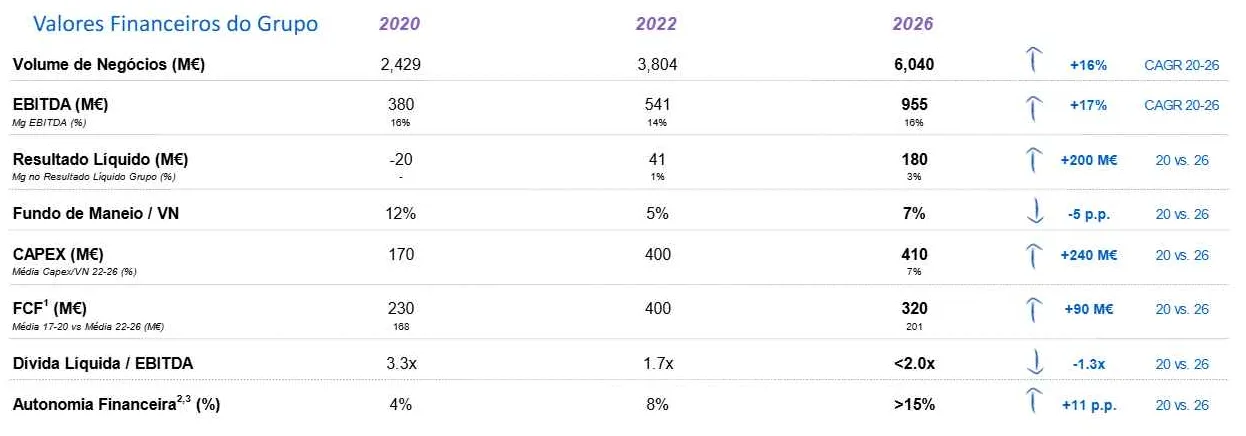
As we can see, and as covered earlier, to meet this plan set out by management it is necessary to raise profitability (to take the net margin from the current 2.5% to 3%), and that is because revenue has practically been reached. Honestly, even with the current rise in the oil price, I believe in management, if only for the trump card of the asset rotation strategy they have been applying.
Before doing the arithmetic on the company’s intrinsic value, I just want to leave a note on oil, because I see an opportunity here that may go unnoticed. As we know, this rise in the oil price has bad consequences for the sector: more inflation, higher interest rates, a higher cost of debt, higher operating costs… that carousel of negativity we already know. Even so, I see an opportunity here for Mota, because, as we can see from the backlog shown earlier, some of Mota’s clients depend on oil for their revenues, which could drive an increase in investment on their part and, consequently, an increase in the quality of Mota’s backlog. Let me give an example so you can see it. Angola drew up its 2026 state budget with a reference price of 61 dollars a barrel. Now, because of the war in Iran, we have had the barrel of oil constantly above 80 dollars. What will happen to this budget surplus? We may see an increase in public spending. So it is reasonable to expect more works in Angola than forecast, works that Mota-Engil can take advantage of. What goes for Angola goes for Nigeria and, recently, Brazil, among other clients.
Now, moving on to the arithmetic, and trusting that management delivers on its promises for the reasons described above, a 2026 profit of €180M and the 306,775,950 shares that make up the company’s share capital give us a rounded EPS of 0.587.
€180,000,000 ÷ 306,775,950 shares = €0.587 per share
At the current share price, if we work out the P/E ratio, we get a 2026 P/E, at today’s price, of 7.6:
€4.48 ÷ €0.587 = 7.63 P/E
Being conservative, and knowing that we have to take other factors into account, such as the debt, as well as others I will cover below, an acceptable P/E for Mota-Engil, also taking comparable construction companies into account, would be around 15. And that is the P/E I find acceptable for the backlog, the debt and the current macroeconomic backdrop around Mota. It is also important to say that if Mota manages to deliver this guidance, surprising the analysts, it will probably see an expansion of its current multiples.
With a P/E of 15, which I do not consider anything extraordinary, Mota-Engil should be trading, if it delivers the €180M of net profit at the end of this year, at 8.8 euros, which is to say practically double the current price.
15 × €0.587 = €8.805 per share
Even without fully delivering the guidance, I believe there is plenty of room for the share to stay at an attractive price with net profit coming in below management’s expectations.
The company also recently released guidance for 2030, but I do not want to focus on that one because it is further away and, as such, less checkable in the short term.
Technical analysis
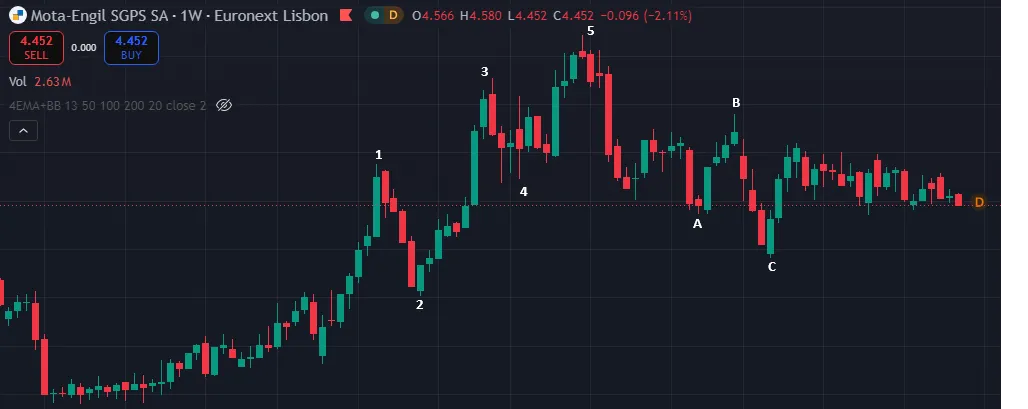
On the technical analysis, what I can see, since September 2024, is an Elliott Waves pattern followed by a massive sideways move (weekly view):
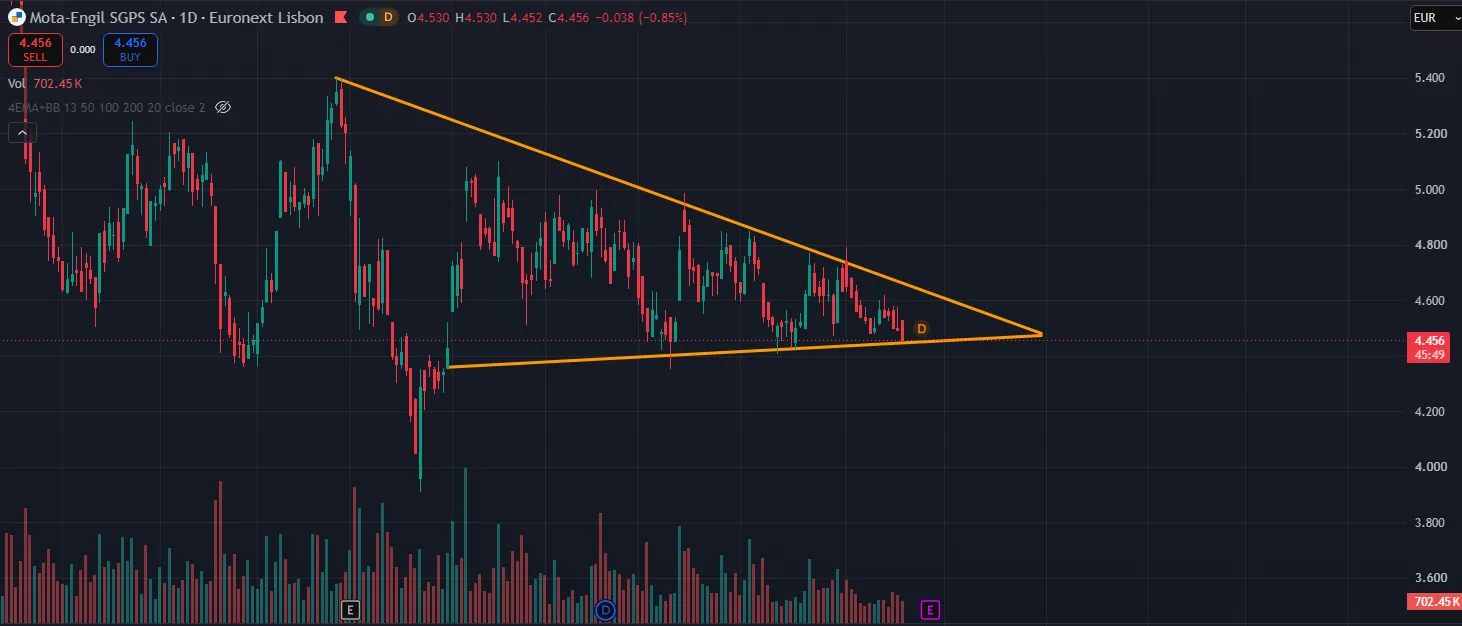
Closer to the short term, on the daily view, we are inside a triangle, which I doubt will break before the results:
It is also important to say that we went to the Golden Pocket of the fall in the supposed wave C of the Elliott Waves, and the price carried on falling:
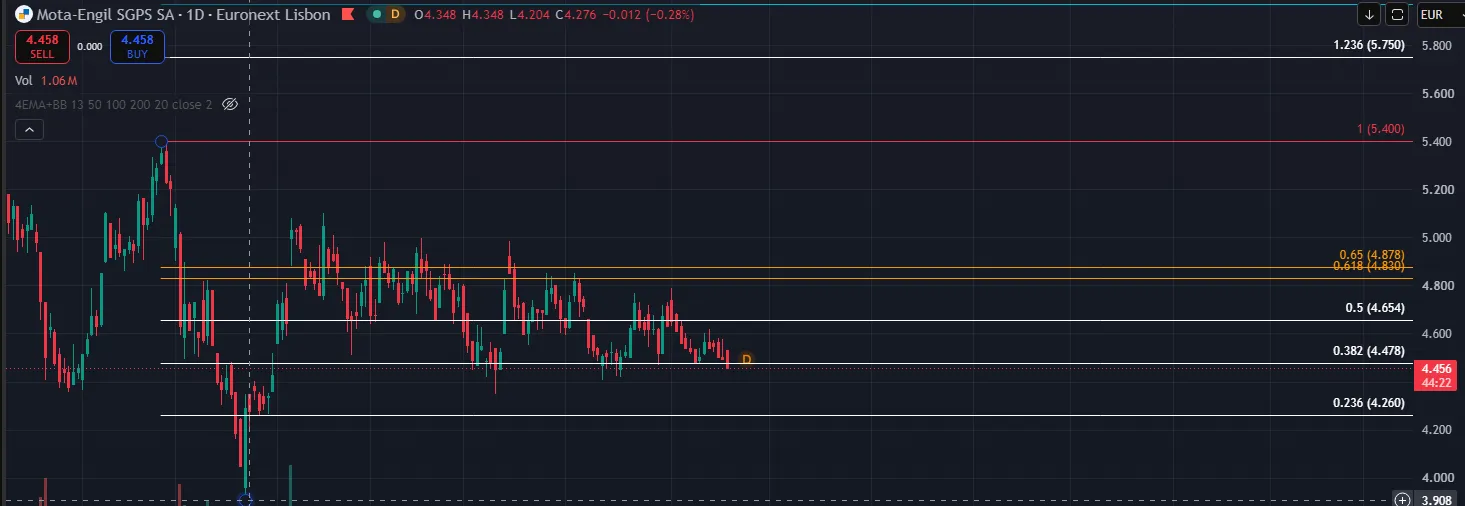
My view is that, in terms of trend, the results coming up will be decisive, given the massive accumulation / distribution going on that makes technical analysis harder. On the stochastic indicator, both on the daily and on the weekly time frame we are fairly neutral.
Technically, after an Elliott Waves pattern, after wave C, the trend returns to the initial trend, so the most likely thing would be a return to an uptrend.
Honestly, I think that for this specific case, not least because the results are so close, we cannot get much relevant information out of it, so I do not have much more to add. All that is left is to wait for the results.
Risks
Obviously there are underlying risks that I want to list:
1. Devaluation of the local currencies of the countries where Mota operates. Although Mota is signing its contracts mostly in dollars, it is still receiving some of its revenue in local currencies such as the kwanza, the Mexican peso, the real and so on. Some of these countries have high inflation and it is always a risk to bear in mind.
2. The geographies where it operates. The geography Mota operates in is a double-edged sword. On one hand these are geographies with great growth potential, on the other, they are geographies with high levels of corruption and some of them with a lot of political and social instability. It is a factor I believe to be the dominant one behind Mota’s currently low multiples.
3. Sizeable short positions. Right now, according to the CMVM, the Portuguese securities regulator, there are significant short positions open. One of them is Muddy Waters’, a fairly significant American fund. That fund even has a court case against Mota-Engil and the current CEO, Carlos Mota Santos, for defamation. The numbers, as of today, are these:
| Holder | Position | Disclosed |
|---|---|---|
| Eleva Capital | 0.93% | 21 Jan 2026 |
| Muddy Waters Capital Domino Master Fund | 0.57% | 20 Nov 2024 |
| Total disclosed | 1.50% |
4. A negative macroeconomic path. We live in challenging times, and the Engineering and Construction sector is quite sensitive to economic cycles. That has to be taken into account.
Conclusion
From the analysis I have done, I can conclude that the first-half results on 27 August 2026 could be decisive and act as a catalyst for this short-term sideways move. Even so, as of today I consider its share price attractive. Everything will depend on whether the company’s management manages to deliver the guidance it gave and to win investors’ confidence. It is a listed company with a relatively high beta, given the little liquidity available (we only have 20-30% free float), so for there to be purchases or sales of large amounts, it is normal for the price to move more. Honestly, I intend to keep my position, which, for my portfolio, is already of a considerable size (I have been accumulating since 2024).
I hope I have not been too tedious, and that I have contributed something to making this company better known!
My best regards, and good investing!
Keep reading
Analysis24 min read
Kaspi.kz: A Bargain Straight Out of Kazakhstan?
An analysis of Kaspi.kz at 105.21 USD, a company almost nobody in Portugal has heard of that earns more than 2 billion dollars a year in a country of 20 million people.
Note2 min read
Grocer's Arithmetic
Mota-Engil's H1 2026 results. Let us get to the arithmetic.