The ABC of investing in shares
Why money sitting still loses value, what shares and ETFs are, how to choose a broker, and what compound interest does to 20 thousand euros over 33 years.
By Ricardo Alves · · 7 min de leitura
In this article I am going to try to simplify investing in the financial markets as much as I can — in shares, in this case — while committing to being as honest and as factual as possible.
First of all, I want to make one thing clear: investing in shares is not for every kind of personality. Investing in financial assets without guaranteed capital may not be suitable for everyone, and none of this is an encouragement for you to go running off to invest your money. What follows is a set of facts and my own experience with these assets. We have to be aware, always, that whoever invests always runs the risk of losing money.
Right — disclaimers aside, let us begin.
Why invest in shares, if the capital is not guaranteed?
We have all kept money in a current account, or somewhere else, where it sits «still» and forgotten. We might think: well, the money sitting there is guaranteed, and whenever I need it, it is there, so I will never lose money. Well — you are wrong! Because money is simply paper. It can be printed over and over again, in our case by the Banco de Portugal, as long as the issue is approved by the European Central Bank. What actually matters to our lives is the purchasing power of the money we have. And purchasing power is affected by something we have all been hearing a lot about lately: inflation. With high inflation, our purchasing power goes down. If we leave our money sitting still and inflation runs at 2.3% a year (the figure confirmed by the INE, Portugal’s national statistics institute, for 2025), we lose 2.3% of purchasing power in a year — because our money is simply worth less, or because goods and services are 2.3% more expensive.
There are ways to fight inflation by putting money into options with guaranteed capital (bonds, savings certificates, and others), but of course those options have a lower return potential, even if it is a certain one. For anyone who chooses these alternatives to fight inflation, that is a legitimate choice and better than leaving the money still. Even so — take the option most in fashion, Portugal’s savings certificates: with inflation at 2.3% in Portugal in 2025, even holding our money in one of those, at net rates of return of around 1.8% a year, we are still losing purchasing power to inflation.
By investing in shares, or in share ETFs (Exchange-traded funds), which are basically indices made up of baskets of shares, we get higher returns that can genuinely beat inflation and increase our purchasing power. I will explain these ideas properly further down.
What are shares?
Shares are nothing more and nothing less than fractions of companies. When we buy shares, we are buying a small part of a company. Now, why would a company sell fractions of itself? The answer is simple. To receive financing from shareholders — that is, to raise capital, so it can leverage itself and grow faster. Beyond that, the simple fact of listing on an exchange increases a company’s visibility and credibility, not least because it then has to publish its results and its long-term plan (guidance) periodically. Companies issue shares through IPOs (Initial Public Offerings), which is the moment when a company puts its shares up for sale at a price, and from then on those shares start trading on the open market, on an exchange — with the company receiving an amount of capital from shareholders according to the number of shares and the price it issues them at. To do an IPO, a company has to go through a complex and slow process, but that is perhaps for later; I will not complicate things further for now.
But how do I actually buy shares in a company?
To buy and sell shares we need a financial intermediary — more specifically, a bank or a broker. For that, we need to open a securities account with whichever institution we choose. These institutions charge fees to carry out the buy and sell orders we want, for transacting in a particular market, and even for the currency exchange when we buy shares in markets that do not use the euro (although in some situations we can buy shares outside Europe with euros, through the bank or broker), among others. In my experience, banks generally charge very high fees, discouraging for anyone who wants to start investing with little money. The better-known brokers, which are still connected to banks one way or another, generally charge more accessible fees. To choose your broker, my advice is to look at its fee schedule and match it against your own investment strategy, because every schedule has its quirks. The best-known ones are, for example, Degiro, XTB, Trading212, IBKR and eToro, among others.
I have chosen a financial intermediary — now what?
The way I see it, generalising, there are two attitudes to investing in shares.
The first is for whoever wants to invest with the least possible effort, without needing to learn technical and fundamental analysis of companies, needing only to check the investment now and then and to follow the news and the economic mood in general terms.
That attitude is investing in an ETF, a basket of shares. When we bet on «all the horses», we run smaller risks, but our profits are capped, as is obvious. Even so, the returns can be reasonable and, above all, above inflation.
There are many ETFs to choose from; here are two fairly common ones.
S&P 500
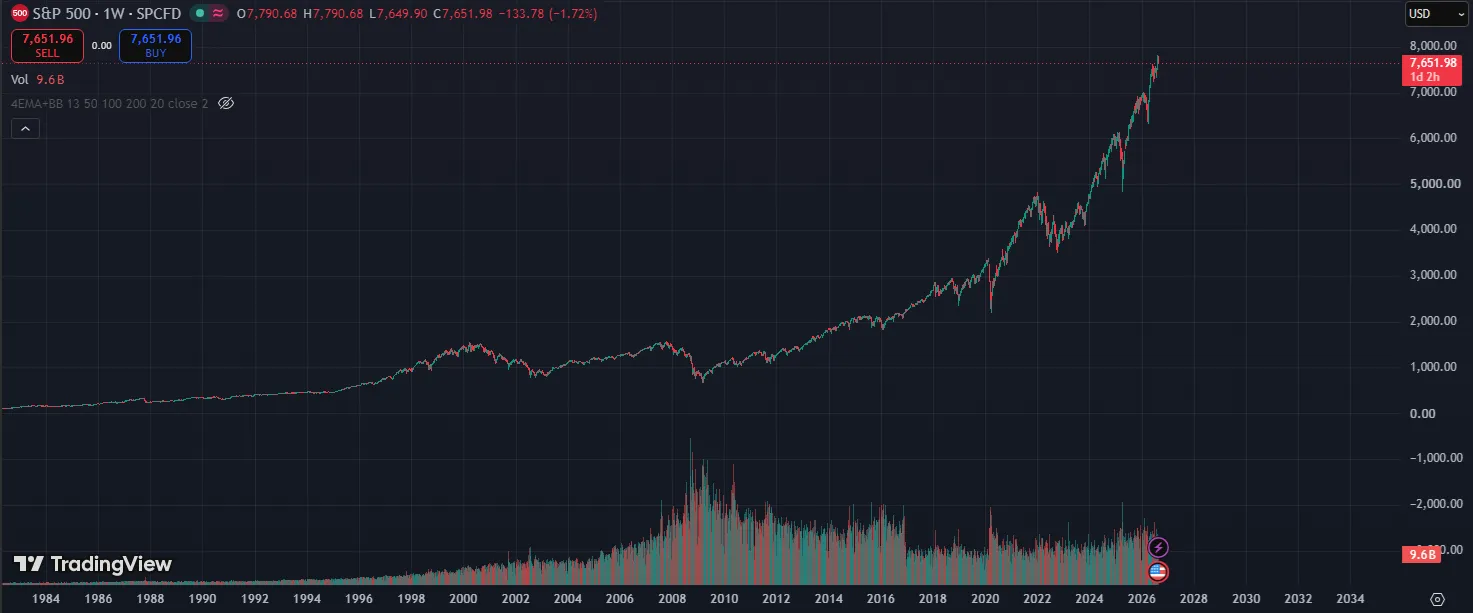
As we can see from the chart, the S&P 500 is an ETF (made up of the 500 largest American companies) which, although it has had years of decline (the 2008 crisis, Covid-19 in 2020, and so on), has a clear upward trend. Over the long run, since 1957, it has averaged a gain of around 10% a year with dividends reinvested, which is well above inflation.
Doing some small sums:
| Year | Capital (€) | Annual gain (€) |
|---|---|---|
| 0 | 20,000.00 | 2,000.00 |
| 5 | 32,210.20 | 3,221.02 |
| 10 | 51,874.85 | 5,187.48 |
| 15 | 83,544.96 | 8,354.50 |
| 20 | 134,550.00 | 13,455.00 |
| 25 | 216,694.12 | 21,669.41 |
| 30 | 348,988.05 | 34,898.80 |
| 33 | 464,503.09 | 46,450.31 |
With starting capital of 20 thousand euros and a profit of 10% a year, we can see that our invested capital grows exponentially.
VWCE (from Vanguard)
This index is made up of a basket of roughly 3,700 shares, which basically represents the economy of the entire world. It is an ETF with less risk than investing only in America, but its return is lower too (around 8% a year).
| Year | Capital (€) | Annual gain (€) |
|---|---|---|
| 0 | 20,000.00 | 1,600.00 |
| 5 | 29,386.56 | 2,350.92 |
| 10 | 43,178.50 | 3,454.28 |
| 15 | 63,443.38 | 5,075.47 |
| 20 | 93,219.14 | 7,457.53 |
| 25 | 136,969.50 | 10,957.56 |
| 30 | 201,253.14 | 16,100.25 |
| 33 | 253,520.99 | 20,281.68 |
Beating the market
The second investor attitude — and the one I chose — is one that aims to make real an expression investors say a great deal: «beating the market». That is, having returns above any index or ETF; in this case, instead of investing in «all the horses», investing in the «right horses».
To manage to «beat the market», we have to pick the right companies, achieving returns within a timeframe we set in our own strategy, whether that is short, medium or long term.
In my experience there is no single right strategy. What matters most is knowing how to value a company and understanding the momentums of the market.
But one thing is certain: to set our strategy and to value a company, we have to take into account two things that for me are the most important ones, whatever the macroeconomic context. Those things are the technical analysis and the fundamental analysis of the company.
It is these two kinds of analysis that, once done, will let us pick the right companies and get above-average returns.
It is a long road of constant learning, but also a very enjoyable road for anyone who wants to go further and earn profits according to their own performance.
To give you an idea: if we manage to beat the S&P 500 and make profits in the order of 15–25% a year (and, contrary to what you read, yes, these returns are possible, with well-founded investing and risk management), the growth of our capital is exponential.
| Year | Capital (€) | Annual gain (€) |
|---|---|---|
| 0 | 20,000.00 | 4,000.00 |
| 5 | 49,766.40 | 9,953.28 |
| 10 | 123,834.73 | 24,766.95 |
| 15 | 308,140.43 | 61,628.09 |
| 20 | 766,752.00 | 153,350.40 |
| 25 | 1,907,924.33 | 381,584.87 |
| 30 | 4,747,526.28 | 949,505.26 |
| 33 | 8,203,725.40 | 1,640,745.08 |
As you can see, the growth is exponential, and after a long enough time it rewards the effort of whoever manages to «beat the market». In this case, after 33 years, where we read 464 thousand euros in the S&P 500 and 253 thousand in the VWCE, we read 8 million euros for a «market beater» with an average return of 20%.
But as the article is running long, I will show how to value a company and what technical analysis and fundamental analysis are in a future article. All the best!
Thank you for your time!
Keep reading
Literacy6 min read
Valuing a company – Fundamental analysis
What a company's results tell us, why a share falls after announcing rising profits, and the weight of expectations and guidance.
Literacy6 min read
Valuing a company – Technical analysis
What technical indicators are for, what kinds of trader exist depending on the time horizon, and how to read a candlestick without memorising shapes.